INTRODUCTION
The application of fiberglass reinforced plastic (FRP) in many applications has long been commonplace.
Understandably, some designers are reluctant to use alternative materials to FRP, including thermoplastics. This may be due to the misconception that thermoplastics aren’t as strong as FRP. In fact, technology for thermoplastics has significantly advanced over the years. Thermoplastics now meet or exceed stringent industry requirements while maintaining impact strength.
IMPACT STRENGTH TESTS
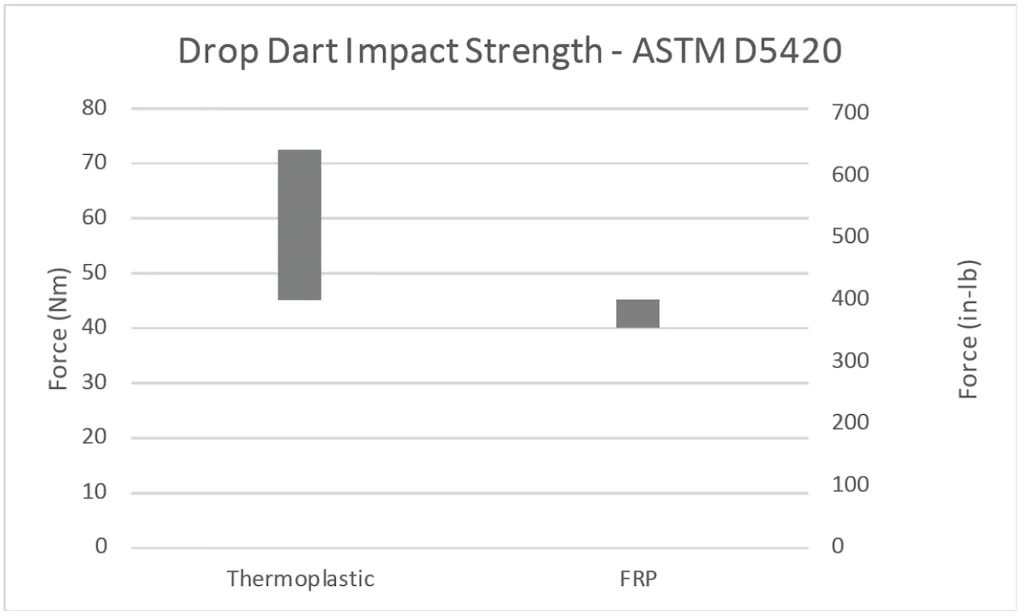
To illustrate the differences between the impact strength of thermopalstics and FRP, we conducted a drop dart impact strength test on each material by closely following ASTM D5420.
THE RESULTS
As illustrated in the chart above, the test results concluded that the maximum force required to penetrate the thermoplastic sheet is higher than the force required to penetrate FRP at the same thickness. In many cases, it’s possible to downgauge thicknesses in thermoplastic materials and still meet the same level of impact strength as FRP. Depending on the application requirements, the impact strength can vary based on the type of thermoplastic selected. The following image illustrates how differently the two materials perform as the impact tester penetrates the materials and secondary surface. The image at left is thermoplastic after the impact test. It shows the material deformed only around the tip of the tester, whereas the FRP panel at right chipped and spread outward from the impact point, releasing glass fiber particles into the atmosphere.
THE CONCLUSION
Our test results conclude that designers could gain resistance to breakage by switching to thermoplastic from FRP. Furthermore, programs requiring additional weight savings and breakage resistance can be obtained by downgauging thermoplastic to a thickness up to 20% thinner than FRP.

TYPICAL THERMOPLASTIC FAILURE

TYPICAL FRP FAILURE