Identification of Blue Inclusions “Blue Dots”
INTRODUCTION
Blue coloured inclusions, (blue dots,) occur on thermoformed KYDEX® thermoplastic sheet. This same phenomena occurs on ABS, polycarbonate and most other types of thermoplastics.
Blue dots are not visible on flat sheet. These inclusions only appear once the sheet is heated or thermoformed and are only found on the surface layer of the material. Typically, the intensity and size of the blue dots increase as more heat is applied during the forming process. Blue dots are most visible in light-coloured thermoformed parts, usually in the family of white colour.
TEST RESULTS
Independent laboratories identified the ‘blue dots’ as a blue dye, most likely from the Copper Phthalocyanine Blue family (Cu-Pc). This material is typically used as a colourant in inks, enamels, plastics, paints and textiles. Although SEKISUI SPI uses a Phthalo Blue pigment, none of the complaints for sheets with ‘blue dot inclusions” have contained this type of colourant.
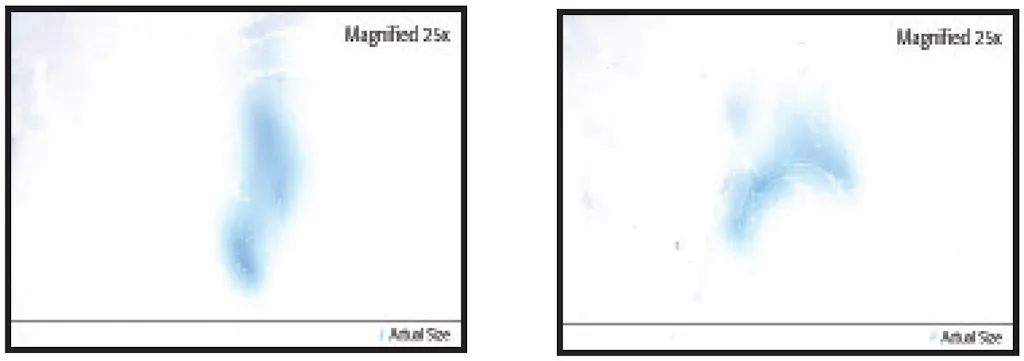
Figures 1 and 2: “Blue dots” under magnification
The cause of the blue dots is from fibers that have had intimate contact with the surface while the sheet is being heated for thermoforming. As the sheet is heated, the dye from the dark fibers transfers colour to the surface of the sheet. Most fibers do not remain on the surface (or in the same region) after the heating process due to handling or air movement. It is important to remember that the fibers are not imbedded in the surface but are simply laying on the surface. Further analysis, from a third party lab experiment, has shown that surface fibers that had transferred blue dye were characteristic of cellulose (ex. cotton).
ACTIONS TAKEN
SEKISUI SPI has taken the following actions to minimize the occurrence of blue dots:
- Change colour of production uniforms from blue to beige or white.
- Replace coloured rags with white rags.
- Quarantine the mezzanine from the extruders. A wall has been constructed on the mezzanine to minimize possible contamination from loose fibers or particles that may fall onto the surface of the sheet as it is processed by the texture rollers.
SUMMARY
SEKISUI SPI has taken all the appropriate measures in-house during production to control fiber contamination. The environment of customers’ facilities is beyond our control. We encourage our customers to minimize the possibility of blue dots by taking similar measures in their facilities.
In addition, we suggest that the unformed KYDEX® sheet be cleaned with an alcohol wipe before thermoforming. Thermoplastics can become statically charged, which makes it very difficult to remove all fibers without introducing new ones. An alcohol wipe will temporarily reduce the static charge, but recognize that not all fibers can be removed completely.
SEKISUI SPI POSITION
Based on the conclusions and analysis of independent testing laboratories, SEKISUI SPI has determined that blue dots are most likely to occur in areas outside of our control. Therefore, SEKISUI SPI will not extend credits or compensation for any blue dot complaints.
Because we cannot anticipate or control the many different conditions under which this information and our products may be used, we do not guarantee the applicability of the accuracy of this information or the suitability of our products in any given situation. Users should conduct their own tests to determine the suitability of each product for their particular purposes. Data in the physical property table represents typical values and are to serve only as a guide for engineering design. Results are obtained from specimens under ideal laboratory conditions. Right to change physical properties as a result of technical progress is reserved. THE PRODUCTS DISCUSSED ARE SOLD WITHOUT WARRANTY OF MERCHANTABILITY OR FITNESS FOR A PARTICULAR USE, EITHER EXPRESSED OR IMPLIED, EXCEPT AS PROVIDED IN OUR STANDARD TERMS AND CONDITIONS OF SALE. Buyer assumes all responsibility for loss or damage arising from the handling and use of our products, whether done in accordance with directions or not. In no event shall the supplier or the manufacturer be liable for incidental or consequential damages. Also, statements concerning the possible use of our products are not intended as recommendations to use our products in the infringement of any patent. Consult local code and regulatory agencies for specific requirements regarding code compliance, transporting, processing, recycling and disposal of our product. Product not intended for use as a heat resistant surface. Texture, product grade and other conditions may cause variations in appearance.
This information supersedes all previously published data.