Hot Gas Welding KYDEX® Thermoplastic Sheet
GENERAL INFORMATION
Hot gas welding is a fabrication process for thermoplastic materials. The process uses a stream of heated gas, usually air, to heat and melt both the thermoplastic substrate material and the thermoplastic welding rod. The substrate and the rod fuse to produce a weld. To ensure welding takes place, adequate temperature and pressure must be applied to the rod, along with the use of the correct welding speed and gun position.
Compressed air is popular since it gives satisfactory results for many purposes and is cheap. Plastics that can be welded are PVC, polyethylene, polycarbonates and nylons. The main advantage of this process is that large, complex fabrications can be constructed. This process is slow and the weld quality is entirely dependent on the skill of the welder.
KYDEX® sheet can be joined to itself and to other materials by hot gas welding. The sheet edges to be joined should be beveled to accommodate the bead, which produces the weld. For best results, sheet thickness should be within the range of 2.00 to 3.18mm (0.080” to 0.125”). Considerable skill is required in hot gas welding to obtain consistent high strength joints.
The tools required for the hot gas welding of seams include:
- Leister Hot Jet “S” welding gun or appropriate substitute
- Speed welding nozzle for 4mm welding rod
- Trim plate and spatula knife for removing excess PVC welding rod
- Router or groover to provide the specified bevel to the edges of the KYDEX® sheet
These tools may be purchased in the US from one of the following sources:
Columbine Int’l
Placerville, CA
800.635.6693
Janser Inc.
Benton Harbor, MI
800.245.2120
Winkleman Sales
Buffalo, NY
716.826.6414
In the US, welding rod for KYDEX® sheet can be purchased by contacting V & A Process, Inc. They have a list of standard colours or they can colour match for specific needs.
V & A Process Inc
1230 Colorado Ave
Lorain, OH 44052
Phone: 440.288.8137
Fax: 440.288.2323
Internationally you can locate the Leister Hot Jet “S” welding gun or appropriate substitute at www.hotairtools.com Internationally the Tarkett welding rods can be located through www.domcotarkettcommercial.com Internationally the Forbo welding rods can be located through www.forbolinoleumna.com
For best results when hot gas welding, the following steps should be done prior to welding:
- Allow a continuous uniform gap of 1.50mm (0.063”) between the KYDEX® sheets.
- Bevel the edges of the KYDEX® sheet with a router or groover to make a “V” shape. The open end of the “V” should be exposed to the welding gun. The edges of the open end “V” should be no more than 3.18mm (0.125”) apart.
- Wipe the seams with mineral spirits.
- Set the temperature and air flow settings on the welding gun. You may have to try different settings of both temperature and air flow to find what works the best. Practice the welding procedure on scrap pieces of KYDEX® sheet to test the acceptability of the welding rod and to adjust the welding gun controls to what works best for your welding style.
TECHNIQUES
General:
- Preheat rod and base of the sheet before welding.
- When starting a weld, keep the rod and torch at a 90° angle from the surface being welded.
- During welding keep the welding rod and torch at a 45° angle.
- Keep a constant pressure and heat balance while welding
- Too much pressure will stretch the bead
- Too much heat will char, melt, or distort the weld. Note: Keep the torch tip approximately 0.250” to 0.750” away from the surface being welded
- Slowly move the welding gun as the welding rod is fused to the KYDEX® sheet. Ideally the welding rod and KYDEX® sheet will give a “liquid” appearance as they fuse together.
- Allow the welding seam to cool to room temperature. Make a first trim of the excess welding rod with the trim plate and spatula knife. Trim the welding rod flush to the KYDEX® sheet using the spatula knife only.
Slow Speed Welding (rod and heat source held separately):
- It is good to keep the surface of the material being welded shiny and tacky during preheating
- If the surface is heated enough the welding material will stick very well to the surface.
- During welding a continuous and equal heating of the surface in a circular motion (two oscillations per second) will help make a very good weld
- While welding apply a continuous force of approximately 3 pounds on the welding rod.
- The applied pressure will create a molten wave of filler and help the rod move forward with the incorporated
- 45° angle. Note: During the welding, to reposition grip on the welding rod:
- Remove the heat from the welding process.
- Let the rod sit with the applied pressure.
- Once the rod solidifies, reposition grip and resume welding. Note: A welding speed of 6-8” per minute should be kept while slow speed hot gas welding.
- To finish the weld:
- Stop at the end while still heating the surface.
- Let the rod cool down slightly.
- Break or cut the remaining welding rod off.
- If the weld fails, it will most likely be due to a bad start of the weld.
TECHNIQUES
High Speed Welding (rod and heat combined in tool):
- High speed welding is similar to slow speed welding in technique, but utilizes some different tools
- High speed welding is good for production, but it is not well suited for small intricate work.
- With a high speed welding device, speeds of up to 1,016mm (40”) per minute may be obtained.
- High speed welding is a faster and more uniform process than slow speed welding.
- High speed welding uses a welder with a high speed tip for uniform and balanced welding.
- The pointed shoe at the end of the welding tip applies pressure on the rod and eliminates a need for pressure to be applied by the operator.
- The tip also smooths out the rod during welding for uniform fit and finish.
- There are different shapes and sizes of welding tips.
- Round, Flat, Triangular
- Insert the welding rod into the high speed tip. Extend an extra 152.40mm (6”) of welding rod and hold it firmly in place
- A good high speed weld in a “V” joint should have a slightly higher crown than a normal hand slow weld and more uniformity as well.
- Dressing or grinding of welds is not good for the weld and should not be done unless a flat surface is required
- This may reduce the strength of the weld by 25% and leave definite weakness in the bond between the base and the welding rod used.
- Bad welds should be removed completely to avoid weaknesses in the part.
- Welds equivalent to less than 75% of the original strength of the material strength should be considered as unsatisfactory.
- Welds should be at least visually inspected for deformities causing the weld to be bad.
- Non-destructive testing may also be used to detect deformities in the weld.
- This may consist of x-rays, etc. depending on end use.
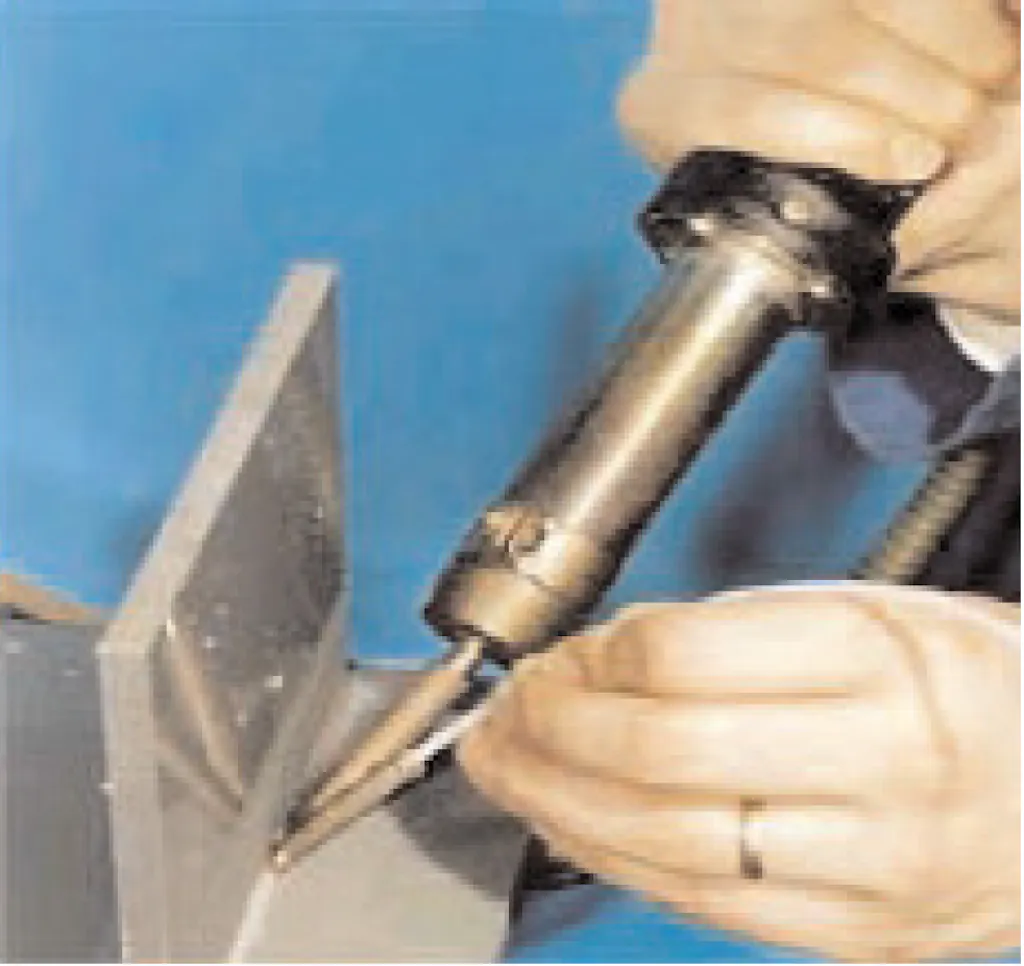
The following is a picture of a high speed hot gas welding tool that is used in production:
TROUBLESHOOTING
Burning of the KYDEX® sheet or welding rod indicates that either the temperature of the welding gun is too high or the operator is welding the seam too slowly.
A failure of the KYDEX® sheet to fuse to the welding rod indicates that either the temperature of the welding gun is too low, the operator is welding the seam too quickly, or the welding rod is incompatible with the KYDEX® sheet.
MAINTENANCE
Small char and burn marks may be removed by wiping a small amount of acetone on the affected area. However, over-application of the acetone solvent may damage or discolour the KYDEX® sheet panel and/or welding rod.
Because we cannot anticipate or control the many different conditions under which this information and our products may be used, we do
Because we cannot anticipate or control the many different conditions under which this information and our products may be used, we do not guarantee the applicability of the accuracy of this information or the suitability of our products in any given situation. Users should conduct their own tests to determine the suitability of each product for their particular purposes. Data in the physical property table represents typical values and are to serve only as a guide for engineering design. Results are obtained from specimens under ideal laboratory conditions. Right to change physical properties as a result of technical progress is reserved. THE PRODUCTS DISCUSSED ARE SOLD WITHOUT WARRANTY OF MERCHANTABILITY OR FITNESS FOR A PARTICULAR USE, EITHER EXPRESSED OR IMPLIED, EXCEPT AS PROVIDED IN OUR STANDARD TERMS AND CONDITIONS OF SALE. Buyer assumes all responsibility for loss or damage arising from the handling and use of our products, whether done in accordance with directions or not. In no event shall the supplier or the manufacturer be liable for incidental or consequential damages. Also, statements concerning the possible use of our products are not intended as recommendations to use our products in the infringement of any patent. Consult local code and regulatory agencies for specific requirements regarding code compliance, transporting, processing, recycling and disposal of our product. Product not intended for use as a heat resistant surface. Texture, product grade and other conditions may cause variations in appearance.
This information supersedes all previously published data.