Environmental Aspects of KYDEX® Thermoplastic Sheet
HOW DOES KYDEX® SHEET AFFECT THE ENVIRONMENT?
Recycling:
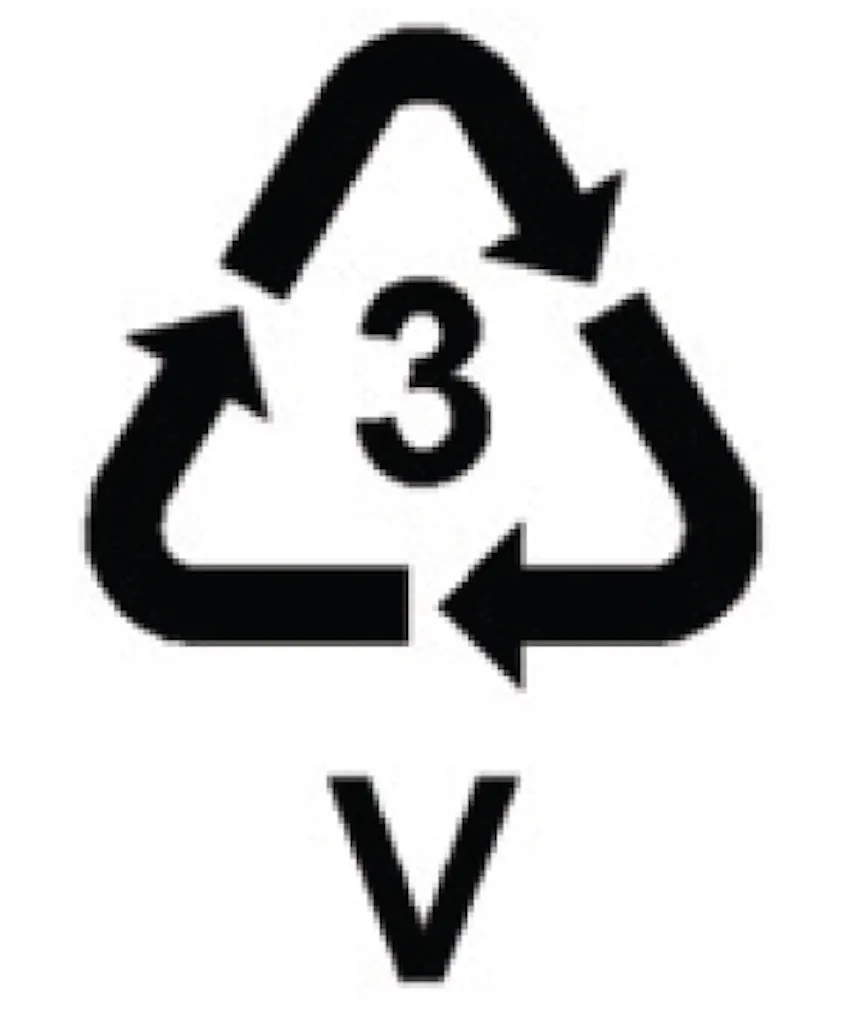
KYDEX® sheet (PVC-U, Unplasticized) is particularly well suited for recycling because it is a thermoplastic, meaning that it can be reprocessed using heat with minimal change in properties. The logo associated with PVC is shown here.
Landfilling:
KYDEX® sheet is extremely resistant to the corrosive conditions found in landfills and will not break down or degrade under them.
Chlorine:
KYDEX® sheet won’t harm the atmosphere. Once chlorine is processed into vinyl, it is chemically locked into the product more tightly than it was in salt. When vinyl is recycled, landfilled, or disposed of in a modern incinerator, chlorine gas is not released into the atmosphere.
Incineration:
The amount of dioxins produced by KYDEX® sheet (PVC) in fires is found to be “insignificant”. Dioxin is a universal phrase used to refer to polychlorinated dibenzo-p-dioxins (PCDDs) and polychlorinated dibenzofurans (PCDFs), which are created in small amounts in a variety of natural and synthetic chemical processes. Incineration, forest fires, metal melting and certain industrial and processes involving chlorine and other organic compounds all have the potential to create dioxin.
According to an American Society of Mechanical Engineers (ASME) report that involved more than 1,999 test results conducted throughout USA in 1995, researchers found no significant correlation between the chlorine content of waste and dioxin emissions. Instead, the study stated incinerator design and operating conditions are the critical factors in dioxin generation and emissions. Modern incinerators operating at a temperature above 850ºC will not contribute to any significant amount of dioxin during incineration.
ARE THERE ANY HAZARDS WHEN BURNING KYDEX® SHEET?
KYDEX® sheet (PVC) has inherent fire-retardant properties, hence it will resist ignition much longer than other materials and will often self-extinguish when a flame source is removed. It is well known that chlorine is one of the few elements that confers good fire properties to a polymer. This will help to slow or even stop the spread of a fire. The combination of fire gases released when KYDEX® sheet burns are very similar to burning wood, fabric and other materials commonly found in a building and fires involving KYDEX® sheet are no more toxic than any other fire.
The toxicity of building fire emissions from KYDEX® sheet is neither better nor worse than for many other common materials. The most important products in any fire are heat, smoke and carbon monoxide.
WHEN KYDEX® SHEET BURNS, DOES IT GIVE OFF HIGHLY TOXIC FUMES?
KYDEX® sheet (PVC) is specified for building materials and is favored by fire authorities is because of its excellent fire prevention properties. KYDEX® sheet, is very difficult to ignite and, in the absence of a powerful external flame, will not continue to burn. When PVC burns, it releases hydrogen chloride and carbon monoxide but burns with lower heat releases which are important since high release rates of some materials will accelerate any fire and its propagation. But any accidental fire produces carbon monoxide and it is this gas, plus heat, which is the major cause of fire deaths. Carbon monoxide is colourless and odorless and therefore victims are not aware they are breathing it. By contrast, very small quantities of hydrogen chloride irritate the human nose and provide an early warning of fire.
DOES KYDEX® SHEET CONTAIN ANY TOXIC ADDITIVES?
KYDEX® sheet does not contain any plasticizers, brominated fire retardants, or heavy metal stabilizers, including lead and cadmium.
Plasticizers:
Plasticizers are used as softening agents and provide low temperature flexibility and weldability. Brominated Flame Retardants: PentaBDE, OctaBDE, and DecaBDE are brominated flame retardants typically used in thermoplastics such as ABS, Polyethylene, Polyurethane, or Polystyrene to help comply with the stringent UL 94 fire standard. KYDEX® sheet has inherent flame retardant properties so no flame retardant additives are necessary to comply with such a standard.
Stabilizers:
Most stabilizers are used in rigid vinyl applications such as construction products thanks to their processability and durability. Lead and cadmium-based stabilizers are used principally in vinyl wire and cable insulation. KYDEX® sheet does not contain any lead or cadmium.
WHAT ARE DIOXINS?
“Dioxin” is a term for a family of persistent chemicals (i.e., substances that do not break down chemically or break down very slowly) that are created through various natural and synthetic processes including incineration, forest fires, metal smelting, and certain industrial operations involving chlorine and other organic compounds. Because chlorine can be found almost everywhere on earth (e.g., in salt), dioxin will be formed when most things burn, including wood, food, garbage and vinyl.
Studies have shown that when burning is well controlled as it is in modern incinerators, very little dioxin is made or emitted. The amount of chlorine or vinyl going into the incinerator is not a reliable indicator of the amount of dioxin coming out. Rather, incinerator design and operation have far more important impacts. However, in uncontrolled burning (e.g., volcanoes, forest fires, old incinerators, backyard burn barrels and accidental building fires), dioxin can be formed in larger amount.
DOES KYDEX® SHEET MEET THE ROHS DIRECTIVE?
The ROHS directive is often referred to as “Lead-Free” legislation. The proper name for ROHS is: Directive 2002/95/EC “The restriction of the use of certain hazardous substances in electrical and electronic equipment” and it applies to the following substances:
- Lead (Pb) : <1000ppm
- Mercury (Hg): <1000ppm
- Cadmium (Cd): <100ppm
- Hexavalent Chromium (Cr (VI)): <1000ppm
- Polybrominated biphenyls (PBBs): <1000ppm
- Polybrominated diphenyl ethers (PBDEs): <1000ppm
- Bis (2-Ethylhexyl) phthalate (DEHP): < 1000 ppm
- Benzyl butyl phthalate (BBP): < 1000 ppm
- Dibutyl phthalate (DBP): < 1000 ppm
- Diisobutyl phthalate (DIBP): < 1000 ppm
In order to comply with the EU ROHS legislation all of these substances must either be removed, or must be reduced to within maximum permitted concentrations (.1%), in any products containing electrical or electronic components that will be sold within the European Union.
All KYDEX® sheet complies with this directive. Please see Technical Brief 110-B for more details. For more information, please visit http://www.rohsdirective.com
WHAT IS THE VINYL 2010 INITIATIVE IN EUROPE AND HOW DOES THIS AFFECT KYDEX® SHEET?
Vinyl 2010 is an initiative in Europe that has many companies covering an entire production chain that decided to work together in an effort to make their industry more sustainable. The European PVC industry has embarked on a 10-year plan to enhance its sustainability profile by relentlessly improving production processes and products, investing in technology, minimizing emissions and waste and boosting collection and recycling.
Central to their approach is the voluntary commitment of the European PVC industry.
Vinyl 2010 is the instrument to deliver the industry’s commitments. It groups European vinyl resin manufacturers, plastic converters and producers of stabilizers and plasticizers. The four founding members are: The European Council of Vinyl Manufacturers (ECVM) European Plastics Converters (EuPC) The European Council for Plasticizers and Intermediates (ECPI) The European Stabilizers Producers Association (ESPA))
WHAT IS THE VINYL 2010 INITIATIVE IN EUROPE AND HOW DOES THIS AFFECT KYDEX® SHEET? (CONT.)
KYDEX® thermoplastic sheet: The European PVC industry is working to develop an integrated waste management approach and environmentally responsible solutions for managing its products at the end of their useful life. It aims to maximize the efficient use of raw materials and to develop the best end-of-life treatment option per waste stream:
Several approaches are followed to reach these targets: mechanical recycling, feedstock recycling, energy recovery and disposal. The PVC industry is currently working to establish effective integrated waste management solutions for both short and long life PVC products. For more on Vinyl 2010 please visit http://www.vinyl2010.org
References:
- Ten Facts to know about Vinyl, The Vinyl Institute, Technical Division (16 Feb 1998), USA.
- Fire and Polyvinyl Chloride, The Vinyl Institute, USA.
- http://www.rohsdirective.com/
- The Facts About Vinyl and Dioxin, The Vinyl Institute, (March 1999), USA.
- Vinyl 2010: http://www.vinyl2010.org/
Because we cannot anticipate or control the many different conditions under which this information and our products may be used, we do not guarantee the applicability of the accuracy of this information or the suitability of our products in any given situation. Users should conduct their own tests to determine the suitability of each product for their particular purposes. Data in the physical property table represents typical values and are to serve only as a guide for engineering design. Results are obtained from specimens under ideal laboratory conditions. Right to change physical properties as a result of technical progress is reserved. THE PRODUCTS DISCUSSED ARE SOLD WITHOUT WARRANTY OF MERCHANTABILITY OR FITNESS FOR A PARTICULAR USE, EITHER EXPRESSED OR IMPLIED, EXCEPT AS PROVIDED IN OUR STANDARD TERMS AND CONDITIONS OF SALE. Buyer assumes all responsibility for loss or damage arising from the handling and use of our products, whether done in accordance with directions or not. In no event shall the supplier or the manufacturer be liable for incidental or consequential damages. Also, statements concerning the possible use of our products are not intended as recommendations to use our products in the infringement of any patent. Consult local code and regulatory agencies for specific requirements regarding code compliance, transporting, processing, recycling and disposal of our product. Product not intended for use as a heat resistant surface. Texture, product grade and other conditions may cause variations in appearance.
This information supersedes all previously published data.